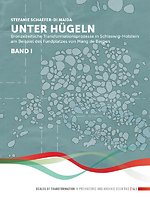
Unter Hügeln (BAND 1)
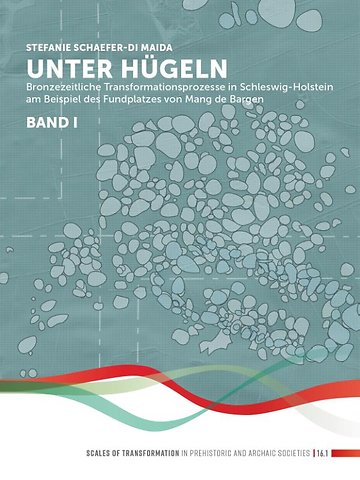
Bronzezeitliche Transformationsprozesse in Schleswig-Holstein am Beispiel des Fundplatzes von Mang de Bargen (Bornhöved, Kr. Segeberg)
Samenvatting
During the Bronze Age the new, eponymous, highly-desired metal spread widely across Europe. It changed labour sectors, networks, worldviews and societies, and brought with it different transformations in diverse areas of life and death. With this book, all changes from the Bronze Age for the area of Schleswig-Holstein were put under the spotlight.
In this framework of research, the Mang de Bargen site near Bornhöved (district of Segeberg), once the target of gravel works, developed into one of the best-dated Bronze Age sites in Schleswig-Holstein. The cemetery was used from the Late Neolithic to the Pre-Roman Iron Age as a burial site. During this long period of use, several cultural changes, including burial rites, grave furnishings, and further activities, can be traced. The rigorous dating of almost all of the graves allows, in particular, the precise identification of the moment of transition from inhumation to cremation, as well as the shift from burial mounds with log coffins to the beginning of the use of urns in northern Germany.
Anthropological analyses of the cremations from Mang de Bargen and other sites in the area also reveal the age-related placement and furnishings, which might in turn stimulate new discussions. A comparison with environmental data (archaeobotany and palynology) also shows the scope of human impact in comparison to the archaeological investigations. The inclusion of data on graves, hoards, and settlements for the whole of Schleswig-Holstein enables this fully-investigated cemetery to be contextually embedded, and shows how — and how differently — transformation processes manifested themselves at local, regional, and supra-regional levels.
Volume 1 comprises the main text, the feature catalogue, the site plans, the main site profiles, the results of the radiometric dating and the interim results of the preliminary anthropological investigations.
Specificaties
Inhoudsopgave
Vorwort der Autorin
1. Einleitung
1.1. Projektvorstellung
1.2. Kooperationen
1.3. Aufbau der Arbeit
2. Transformationsbegriff
2.1. Definition
2.2. Transformationstypen
2.3. Transformationsmodelle
3. Ziele und Fragestellungen
4. Methoden und theoretische Grundlagen
5. Arbeitsgebiet: Geographie und Geologie
5.1. Schleswig-Holstein
5.2. Fundplatz von Mang de Bargen, Bornhöved (Kr. Segeberg)
6. Quellen und Quellenkritik
7. Chronologie der ‚Nordischen Bronzezeit‘
7.1. Forschungsgeschichte
7.2. Bronzezeitliche Chronologie im Arbeitsgebiet
7.3. Eisenzeit
8. Mikroebene: Transformationsprozesse am Fundplatz von Mang de Bargen
8.1. Forschungsgeschichte & Stand der Forschung
8.2. Neue Feldforschungen im Rahmen der Dissertation
8.3. Befunde
8.4. Fundmaterial
8.5. Chorologie des Fundmaterials
8.6. Chronologie
8.7. Leichenbrandanalysen
8.8. Botanische Großrestanalysen
8.9. Pollenanalysen
8.10. Kulturelle Einbettung des Fundplatzes von Mang de Bargen
8.11. Transformationsprozesse am Fundplatz von Mang de Bargen
9. Mesoebene: Transformationsprozesse in Schleswig-Holstein
9.1. Zur Datenaufnahme
9.2. Zur Datenauswertung
9.3. Befunde
9.4. Materielle Kultur
9.5. Formenkunde: Gliederung älterbronzezeitlicher Keramik aus Schleswig-Holstein
9.6. Transformationsprozesse in Schleswig-Holstein
10. Schlussbetrachtung
11. Fazit und Ausblick
12. Literaturverzeichnis
Anhang
I. Katalog
II. Gesamtplana
III. Hauptprofile
IV. Tabelle zu den 14C-Datierungsergebnissen
V. Tabelle zu den vorläufigen anthropologischen Analysen zu den Datierungsproben