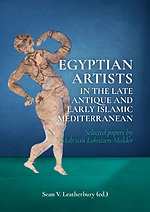
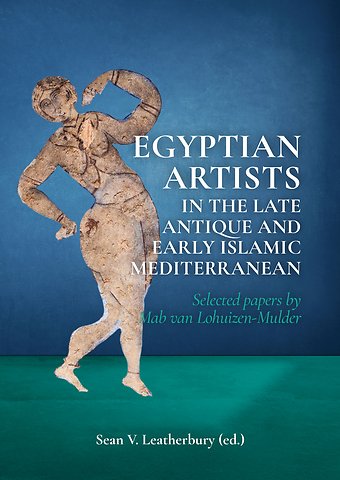
Egyptian Artists in the Late Antique and Early Islamic Mediterranean
Selected papers by Mab van Lohuizen-Mulder
Samenvatting
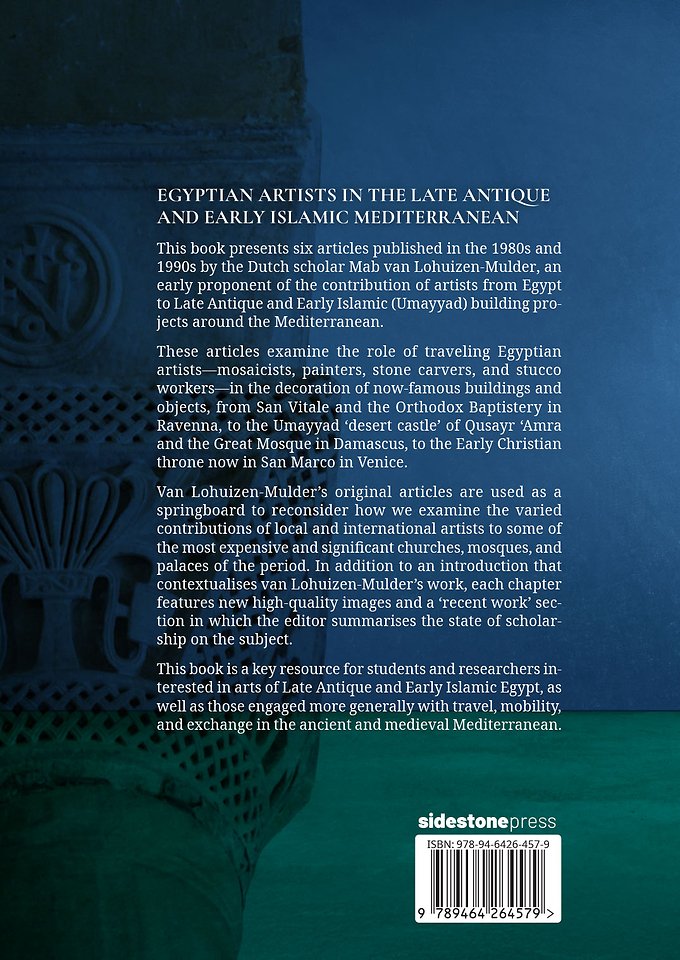
This book presents six articles published in the 1980s and 1990s by the Dutch scholar Mab van Lohuizen-Mulder, an early proponent of the contribution of artists from Egypt to Late Antique and Early Islamic (Umayyad) building projects around the Mediterranean.
These articles examine the role of traveling Egyptian artists—mosaicists, painters, stone carvers, and stucco workers—in the decoration of now-famous buildings and objects, from San Vitale and the Orthodox Baptistery in Ravenna, to the Umayyad ‘desert castle’ of Qusayr ‘Amra and the Great Mosque in Damascus, to the Early Christian throne now in San Marco in Venice.
Van Lohuizen-Mulder’s original articles are used as a springboard to reconsider how we examine the varied contributions of local and international artists to some of the most expensive and significant churches, mosques, and palaces of the period. In addition to an introduction that contextualises van Lohuizen-Mulder’s work, each chapter features new high-quality images and a ‘recent work’ section in which the editor summarises the state of scholarship on the subject.
This book is a key resource for students and researchers interested in arts of Late Antique and Early Islamic Egypt, as well as those engaged more generally with travel, mobility, and exchange in the ancient and medieval Mediterranean.
About Mab van Lohuizen-Mulder
Mab van Lohuizen-Mulder (1934–2013) was a Dutch expert on late antique art and architecture, focusing particularly on architectural decoration and the role of Egypt as incubator and transmitter of artistic styles. She held a PhD in Art History from the University of Utrecht, and was a researcher attached to the Vrije Universiteit Amsterdam and a visiting scholar at the Institute for Advanced Study at Princeton University.
Specificaties
Inhoudsopgave
Preface (Wali van Lohuizen)
Biography of Mab van Lohuizen-Mulder (Wali van Lohuizen)
Author’s Acknowledgments (Mab van Lohuizen-Mulder)
Editor’s Acknowledgements (Sean V. Leatherbury)
Chapter 1: Introduction: From Egypt to the Wider Mediterranean: Tracing Late Antique Egyptian Artists and Motifs with Mab van Lohuizen-Mulder (Sean V. Leatherbury)
Chapter 2: The Mosaics in the Great Mosque at Damascus: A Vision of Beauty (Mab van Lohuizen-Mulder)
The Great Mosque at Damascus: Recent Work (Sean V. Leatherbury)
Chapter 3: Frescoes in the Umayyad Residence and Bathhouse at Qusayr ‘Amra: Paintings Made by Christian Artists from Egypt (Mab van Lohuizen-Mulder)
Qusayr ‘Amra: Recent Work (Sean V. Leatherbury)
Chapter 4: Early Christian Lotus-panel Capitals and Other So-called Impost Capitals (Mab van Lohuizen-Mulder)
Lotus-panel Capitals: Recent Work (Sean V. Leatherbury)
Chapter 5: Two-zone Capitals (Mab van Lohuizen-Mulder)
Chapter 6: Stuccoes in Ravenna, Poreč, and Cividale of Egyptian Manufacture (Mab van Lohuizen-Mulder)
Stuccowork in Ravenna: Recent Work (Sean V. Leatherbury)
Chapter 7: The Cathedra of St Mark in Venice (Mab van Lohuizen-Mulder)
The Throne of St. Mark: Recent Work (Sean V. Leatherbury)
Afterward: Alexandria versus Byzantium (Mab van Lohuizen-Mulder)