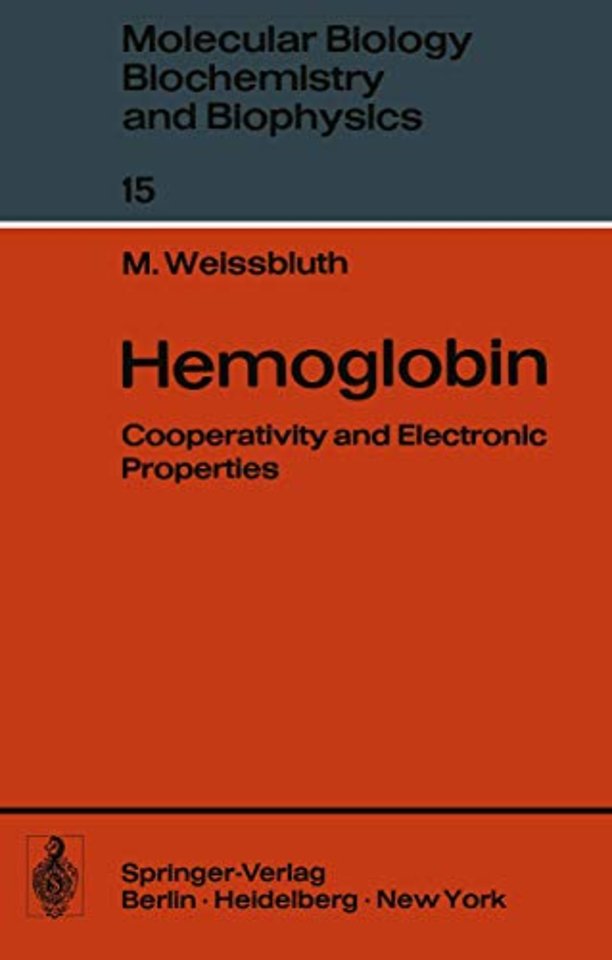
Hemoglobin

Cooperativity and Electronic Properties

Specificaties
Paperback, blz. | Engels
Springer Berlin Heidelberg | 2011
ISBN13: 9783642808036
Rubricering
Springer Berlin Heidelberg 0e druk, 2011 9783642808036
€ 120,99
Levertijd ongeveer 9 werkdagen
Gratis verzonden

Samenvatting

Approximately one third of the mass of a mammalian red blood cell is hemo­ globin. Its major function is to bind oxygen at the partial pressure prevailing in the lungs and to release it to the tissues where the partial pressure is lower. The process whereby hemoglobin performs this essential physiological role is characterized by a cooperative interaction among its constituent subunits. A great deal of research effort has been devoted to this interaction, going back at least as far as the fitst decade of this century. Moreover, cooperativity in hemo­ globin is probably not unique; it may well be one instance of a general class of interactions that occur in biological molecules. Certain enzymes with a variety of regulatory and catalytic functions, for example, contain several sites which interact in a highly specific manner such that the affinity of a given site for the substrate is markedly influenced by the state of binding at the other sites. But whereas we know very little of the structure of most enzymes of this type, hemo­ globin is one of a very small number of biological molecules whose immensely intricate machinery has been revealed to us. We owe this insight to the group under the leadership of M. F. PERUTZ in Cambridge, England, whose research over a period of several decades culminated in a detailed description of the three­ dimensional structure.

Specificaties

ISBN13:9783642808036
Taal:Engels
Bindwijze:paperback
Uitgever:Springer Berlin Heidelberg
Druk:0

Inhoudsopgave

I Amino Acids, Peptides and Proteins.- 1.1 Amino Acids.- 1.2 Peptides.- 1.3 Proteins.- II Hemoglobin.- 2.1 Primary Structure.- 2.2 Spin States.- 2.3 Heme.- 2.4 Secondary and Tertiary Structure.- 2.5 Quaternary Structure.- 2.6 Dissociated Hemoglobin.- III Oxygenation Characteristics.- 3.1 Equilibrium Curves.- 3.2 Quantitative Description.- 3.3 The Bohr Effect.- 3.4 Thermodynamic and Kinetic Properties.- IV Approaches to Cooperativity.- 4.1 The Monod-Wyman-Changeux (MWC) Model.- 4.2 The Koshland-Nemethy-Filmer (KNF) Model.- 4.3 Stereochemical Theory.- 4.4 Magnetic Resonance.- 4.5 Discussion.- V Electronic States of Iron.- 5.1 Free Ions.- 5.2 Cubic Symmetry.- 5.3 Tetragonal and Rhombic Symmetries.- 5.4 One-Electron Energies.- 5.5 Multielectron Configurations.- 5.6 Kramers Theorem.- 5.7 The Jahn-Teller Effect.- 5.8 Molecular Orbitals.- VI Magnetic Properties.- 6.1 General Features.- 6.2 Electron Spin Resonance of Low-Spin Ferrihemoglobin.- 6.3 Electron Spin Resonance of High-Spin Ferrihemoglobin.- 6.4 Paramagnetic Susceptibility.- 6.5 Discussion.- VII Molecular Orbitals and Optical Spectra.- 7.1 Computational Method.- 7.2 Results of Molecular Orbital Calculations.- 7.3 Optical Spectra.- VIII Mossbauer Spectroscopy.- 8.1 General Features.- 8.2 Mossbauer Spectra of Hemoglobin.- 8.3 Theoretical Interpretation and Discussion.- IX Further Aspects.- 9.1 Diamagnetism of Oxyhemoglobin.- 9.2 The Jahn-Teller Effect and Cooperativity in Hemoglobin.- References.
€ 120,99
Levertijd ongeveer 9 werkdagen
Gratis verzonden

Rubrieken

    Personen

      Trefwoorden

        Hemoglobin