,

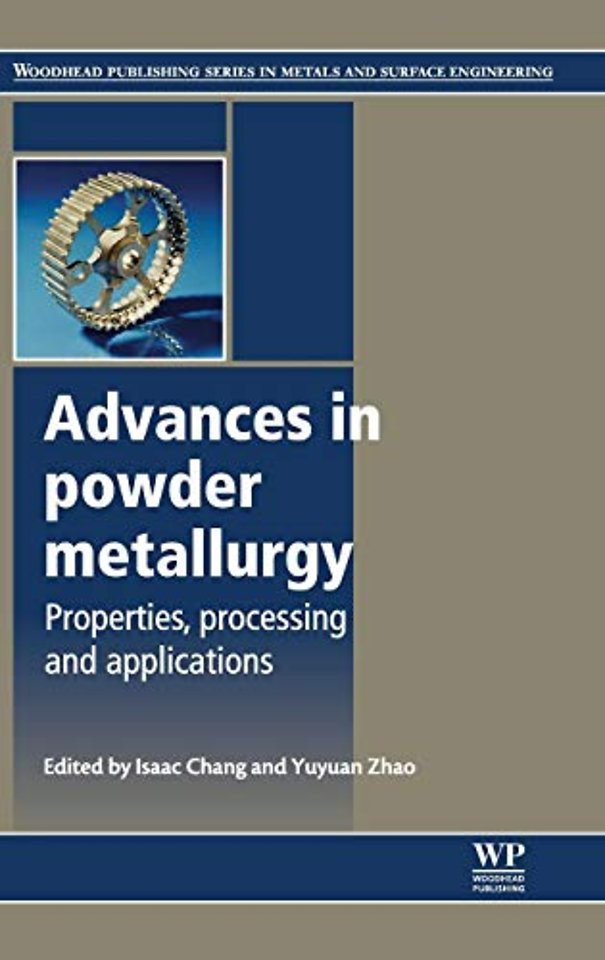
Advances in Powder Metallurgy

Properties, Processing and Applications

Specificaties
Gebonden, blz. | Engels
Elsevier Science | 2013
ISBN13: 9780857094209
Rubricering
Elsevier Science e druk, 2013 9780857094209
€ 271,00
Levertijd ongeveer 9 werkdagen
Gratis verzonden

Samenvatting

Powder metallurgy (PM) is a popular metal forming technology used to produce dense and precision components. Different powder and component forming routes can be used to create an end product with specific properties for a particular application or industry. Advances in powder metallurgy explores a range of materials and techniques used for powder metallurgy and the use of this technology across a variety of application areas.

Part one discusses the forming and shaping of metal powders and includes chapters on atomisation techniques, electrolysis and plasma synthesis of metallic nanopowders. Part two goes on to highlight specific materials and their properties including advanced powdered steel alloys, porous metals and titanium alloys. Part three reviews the manufacture and densification of PM components and explores joining techniques, process optimisation in powder component manufacturing and non-destructive evaluation of PM parts. Finally, part four focusses on the applications of PM in the automotive industry and the use of PM in the production of cutting tools and biomaterials.

Advances in powder metallurgy is a standard reference for structural engineers and component manufacturers in the metal forming industry, professionals working in industries that use PM components and academics with a research interest in the field.

Specificaties

ISBN13:9780857094209
Taal:Engels
Bindwijze:Gebonden

Inhoudsopgave

<p>Contributor contact details</p> <p>Woodhead Publishing Series in Metals and Surface Engineering</p> <p>Part I: Forming and shaping of metal powders</p> <p>Chapter 1: Advances in atomisation techniques for the formation of metal powders</p> <p>Abstract:</p> <p>1.1 Introduction</p> <p>1.2 Atomisation techniques</p> <p>1.3 Problems and advances in gas atomisation</p> <p>1.4 Problems and advances in water atomisation</p> <p>1.5 Centrifugal atomisation</p> <p>1.5.2 Other non-ferrous powders</p> <p>1.6 Other atomisation techniques</p> <p>1.7 Conclusion</p> <p>Chapter 2: Forming metal powders by electrolysis</p> <p>Abstract:</p> <p>2.1 Background of electrometallurgy and powder metallurgy</p> <p>2.2 Principle and main technological prospects for the FFC Cambridge process</p> <p>2.3 Production of metal powders by the FFC Cambridge process</p> <p>2.4 Direct route from oxide precursors to alloyed powders</p> <p>2.5 Conclusions and future trends</p> <p>2.6 Acknowledgement</p> <p>Chapter 3: Mechanochemical synthesis of nanocrystalline metal powders</p> <p>Abstract:</p> <p>3.1 Introduction</p> <p>3.2 Mechanochemical processing</p> <p>3.3 The process</p> <p>3.4 Grain size and process variables</p> <p>3.5 Displacement reactions</p> <p>3.6 Consolidation</p> <p>3.7 Powder contamination</p> <p>3.8 Conclusions</p> <p>Chapter 4: Plasma synthesis of metal nanopowders</p> <p>Abstract:</p> <p>4.1 Introduction</p> <p>4.2 Potential benefits and applications of metal nanopowders</p> <p>4.3 Electrical arc discharge synthesis of metal nanopowders</p> <p>4.4 Conclusions</p> <p>Chapter 5: Warm compaction of metallic powders</p> <p>Abstract:</p> <p>5.1 Introduction</p> <p>5.2 Warm compaction process</p> <p>5.3 Properties of warm compacted parts</p> <p>5.4 Materials and applications</p> <p>5.5 Future trends and concluding remarks</p> <p>Chapter 6: Developments in metal injection moulding (MIM)</p> <p>Abstract:</p> <p>6.1 Introduction to metal injection moulding</p> <p>6.2 Powders for metal injection moulding</p> <p>6.3 Binders for metal injection moulding</p> <p>6.4 Mixing and feedstock analysis</p> <p>6.5 Injection moulding</p> <p>6.6 Binder removal (debinding)</p> <p>6.7 Sintering</p> <p>6.8 Post-sintering</p> <p>6.9 Applications and design</p> <p>6.10 Conclusion</p> <p>Part II: Materials and properties</p> <p>Chapter 7: Advanced powder metallurgy steel alloys</p> <p>Abstract:</p> <p>7.1 Introduction</p> <p>7.2 Composition of advanced pressed and sintered steel components</p> <p>7.3 Manufacturing routes for sintered steel components</p> <p>7.4 Properties, microstructures and typical products</p> <p>7.5 Powder injection moulded steel components</p> <p>7.6 Powder metallurgy tool steels</p> <p>7.7 Trends in ferrous powder metallurgy</p> <p>7.8 Acknowledgements</p> <p>Chapter 8: Powder metallurgy of titanium alloys</p> <p>Abstract:</p> <p>8.1 Introduction</p> <p>8.2 Powders</p> <p>8.3 Near net shapes</p> <p>8.4 Additive layer manufacturing and powder injection molding</p> <p>8.5 Spraying and research-based processes</p> <p>8.6 Future trends</p> <p>8.7 Acknowledgements</p> <p>Chapter 9: Metal-based composite powders</p> <p>Abstract:</p> <p>9.1 Introduction</p> <p>9.2 Metal-based composite powder production</p> <p>9.3 Copper- and aluminium-based composite powder systems</p> <p>9.4 Other metal-based composite powders</p> <p>9.5 Applications</p> <p>9.6 Future trends</p> <p>Chapter 10: Porous metals: foams and sponges</p> <p>Abstract:</p> <p>10.1 Introduction</p> <p>10.2 Powder processing: partial sintering and space holders</p> <p>10.3 Powder processing: gas entrapment and additive layer manufacturing</p> <p>10.4 Properties of porous metals</p> <p>10.5 Prediction of porous metal properties</p> <p>10.6 Future perspectives</p> <p>Chapter 11: Evolution of microstructure in ferrous and non-ferrous materials</p> <p>Abstract:</p> <p>11.1 Introduction</p> <p>11.2 Metallographic preparation techniques for powder metallurgy products</p> <p>11.3 Microstructures of ferrous powder metallurgy materials</p> <p>11.4 Non-ferrous materials</p> <p>11.5 Trends in microstructures of powder metallurgy products</p> <p>11.6 Acknowledgements</p> <p>Part III: Manufacturing and densification of powder metallurgy components</p> <p>Chapter 12: Microwave sintering of metal powders</p> <p>Abstract:</p> <p>12.1 Introduction and background</p> <p>12.2 Sintering of metallic powders</p> <p>12.3 Bulk metal processing</p> <p>12.4 Microwave–metal interaction: mechanism(s)</p> <p>12.5 Future trends</p> <p>Chapter 13: Joining processes for powder metallurgy parts</p> <p>Abstract:</p> <p>13.1 Introduction</p> <p>13.2 Welding processes for powder metallurgy parts</p> <p>13.3 Other joining processes for powder metallurgy parts</p> <p>13.4 Discussion</p> <p>13.5 Conclusions</p> <p>Chapter 14: Process optimization in component manufacturing</p> <p>Abstract:</p> <p>14.1 Introduction</p> <p>14.2 Formal optimization</p> <p>14.3 Optimization in the die compaction process</p> <p>14.4 Powder injection moulding optimization</p> <p>14.5 Sintering optimization</p> <p>14.6 Design optimization of steady-state conduction</p> <p>14.7 Conclusions</p> <p>Chapter 15: Non-destructive evaluation of powder metallurgy parts</p> <p>Abstract:</p> <p>15.1 Introduction</p> <p>15.2 Need and incentive for NDT</p> <p>15.3 Problem/approach concept</p> <p>15.4 Quality control by digital radiographic (DR) inspection in production</p> <p>15.5 Challenges in relation to the state-of-the-art</p> <p>15.6 Real-time on-line powder metallurgy parts inspection</p> <p>15.7 Prior art in relation to radiography of particulate matter and near net-shape parts</p> <p>15.8 Summary</p> <p>Chapter 16: Fatigue and fracture of powder metallurgy steels</p> <p>Abstract:</p> <p>16.1 Introduction</p> <p>16.2 Fracture behavior</p> <p>16.3 Fatigue behavior</p> <p>16.4 Residual stress effects on fatigue</p> <p>16.5 Constitutive behavior of microstructural constituents</p> <p>16.6 Summary</p> <p>16.7 Acknowledgments</p> <p>Part IV: Applications</p> <p>Chapter 17: Automotive applications of powder metallurgy</p> <p>Abstract:</p> <p>17.1 Introduction</p> <p>17.2 Powder metallurgy parts</p> <p>17.3 Materials</p> <p>17.4 Innovative powder metallurgy products</p> <p>17.5 Emerging trends</p> <p>17.6 Conclusions</p> <p>Chapter 18: Applications of powder metallurgy in biomaterials</p> <p>Abstract:</p> <p>18.1 Introduction</p> <p>18.2 Challenges of powder metallurgy biomaterials</p> <p>18.3 Production of powder metallurgy biomaterials</p> <p>18.4 Specific properties of powdered titanium and titanium alloy biomaterials</p> <p>18.5 Specific properties of other powder metallurgy biomaterials</p> <p>18.6 Case studies</p> <p>18.7 Conclusions and future trends</p> <p>18.8 Further reading</p> <p>Chapter 19: Applications of powder metallurgy to cutting tools</p> <p>Abstract:</p> <p>19.1 Introduction</p> <p>19.2 Tool design and composition</p> <p>19.3 Diamond tool fabrication</p> <p>19.4 Application of powder metallurgy diamond tools</p> <p>19.5 Latest trends and developments</p> <p>Index</p>
€ 271,00
Levertijd ongeveer 9 werkdagen
Gratis verzonden

Rubrieken

    Personen

      Trefwoorden

        Advances in Powder Metallurgy