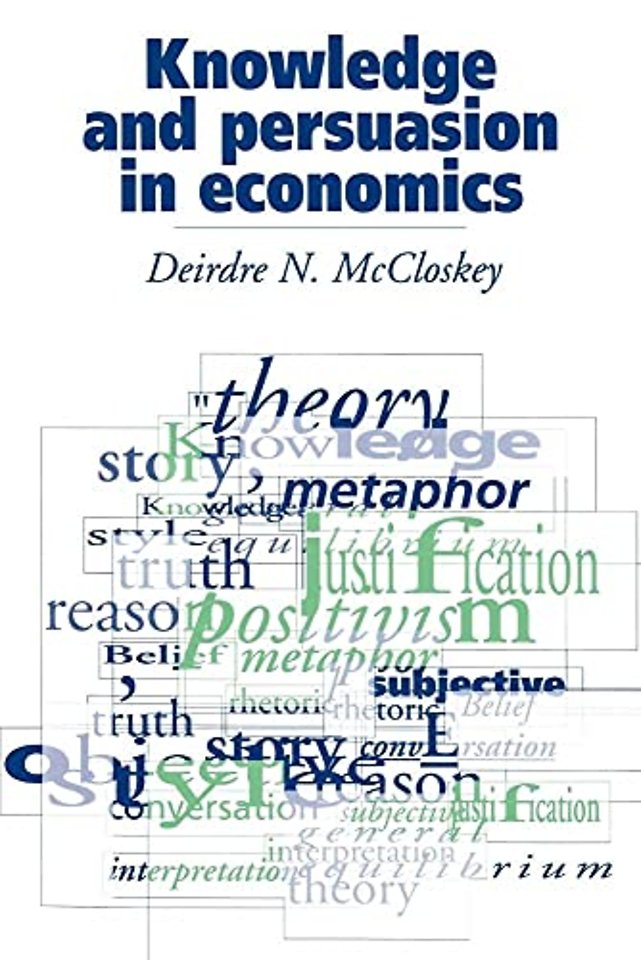
Knowledge and Persuasion in Economics

Specificaties
Paperback, 464 blz. | Engels
Cambridge University Press | 1994
ISBN13: 9780521436038
Rubricering
Cambridge University Press e druk, 1994 9780521436038
€ 33,97
Levertijd ongeveer 9 werkdagen
Gratis verzonden

Samenvatting

Is economics a science? Deidre McCloskey says 'Yes, but'. Yes, economics measures and predicts, but - like other sciences - it uses literary methods too. Economists use stories as geologists do, and metaphors as physicists do. The result is that the sciences, economics among them, must be read as 'rhetoric', in the sense of writing with intent. McCloskey's books, The Rhetoric of Economics(1985) and If You're So Smart(1990), have been widely discussed. In Knowledge and Persuasion in Economics he converses with his critics, suggesting that they too can gain from knowing their rhetoric. The humanistic and mathematical approaches to economics, says McCloskey, fit together in a new 'interpretive' economics. Along the way he places economics within the sciences, examines the role of mathematics in the field, replies to critics from the left, right and centre, and shows how economics can again take a leading place in the conversation of humankind.

Specificaties

ISBN13:9780521436038
Taal:Engels
Bindwijze:Paperback
Aantal pagina's:464

Inhoudsopgave

Part I. Exordium: 1. A positivist youth; 2. Kicking the dead horse; Part II. Narration: 3. Economics in the human conversation; 4. The rhetoric of economics; Part III. Division: 5. The Science word in economics; 6. Three ways of reading economics to criticize itself; 7. Popper and Lakatos: thin ways of reading economics; 8. Thick readings: ethics, economics, sociology and rhetoric; Part IV. Proof: 9. The rise of a scientistic style; 10. The rhetoric of mathematical formalism: existence theorems; 11. General equilibrium and the rhetorical history of formalism; 12. Blackboard Marxism; 13. Formalists as poets and politicians; Part V. Refutation: 14. The very idea of epistemology; 15. The tu quoque argument and the claims of rationalism; 16. Armchair philosophy of economics: Rosenberg and Hausman; 17. Philosophy of science without epistemology: the Popperians; 18. The Rosenberg: reactionary modernism; 19. Methodologists of economics, big-M and small; 20. Getting 'rhetoric': Mark Blaug and the Eleatic Stranger; 21. Coats/McPherson/Friedman: anti-meta-post-modernism; 22. Splenetic rationalism, Austrian style; 23. The economists of ideology: Heilbroner, Rossetti, and Mirowski; 24. Rhetoric as morally radical; Part VI. Peroration: 25. The economy as a conversation; 26. The consequences of rhetoric.
€ 33,97
Levertijd ongeveer 9 werkdagen
Gratis verzonden

Rubrieken

    Personen

      Trefwoorden

        Knowledge and Persuasion in Economics