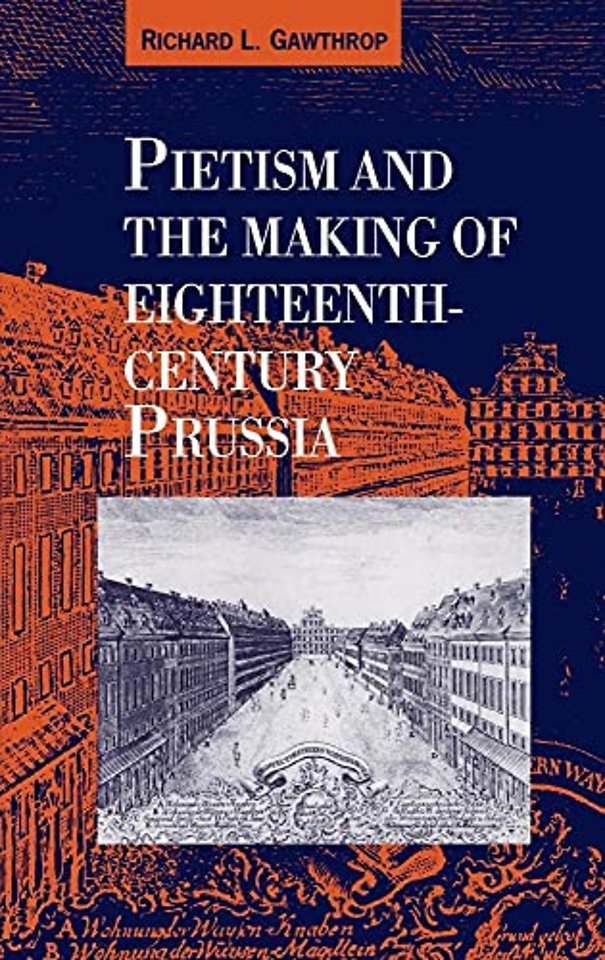
Pietism and the Making of Eighteenth-Century Prussia

Specificaties
Gebonden, 320 blz. | Engels
Cambridge University Press | 1993
ISBN13: 9780521431835
Rubricering
Cambridge University Press e druk, 1993 9780521431835
€ 119,08
Levertijd ongeveer 9 werkdagen
Gratis verzonden

Samenvatting

How did as small and backward a state as Prussia transform itself to compete successfully in war against states with far greater human and financial resources? Richard Gawthrop finds the answer to this perennial question in the creation of a unique political culture, in which service to the Prussian state took precedence over all other relationships and commitments. The campaign to inculcate the new ideology of disciplined energetic obedience to the state authority derived its moral vision and institutional forms from Lutheran Pietism, a German version of ascetic Protestantism strongly influenced by English Puritanism. This work describes systematically how the collaboration between Pietism and the Prussian state not only led to an increase in the latter's power but also laid the cultural basis for the subsequent political modernization of Germany.

Specificaties

ISBN13:9780521431835
Taal:Engels
Bindwijze:Gebonden
Aantal pagina's:320

Inhoudsopgave

Preface; Introduction; 1. The German territorial state in the sixteenth and seventeenth centuries; 2. Reformed confessionalism and the reign of the Great Elector; 3. The nature of the pre-1713 Hohenzollern state; 4. Lutheran confessionalism; 5. Spenerian Pietism; 6. From Spener to Francke; 7. Halle Pietism I: ideology and indoctrination; 8. Halle Pietism II: growth and crisis; 9. Pietist-Hohenzollern collaboration; 10. The impact of Pietist pedagogy on the Prussian army and bureaucracy; 11. Civilian mobilization and economic development during the reign of Frederick William I; Conclusion; Bibliography; Index.
€ 119,08
Levertijd ongeveer 9 werkdagen
Gratis verzonden

Rubrieken

    Personen

      Trefwoorden

        Pietism and the Making of Eighteenth-Century Prussia