, ,

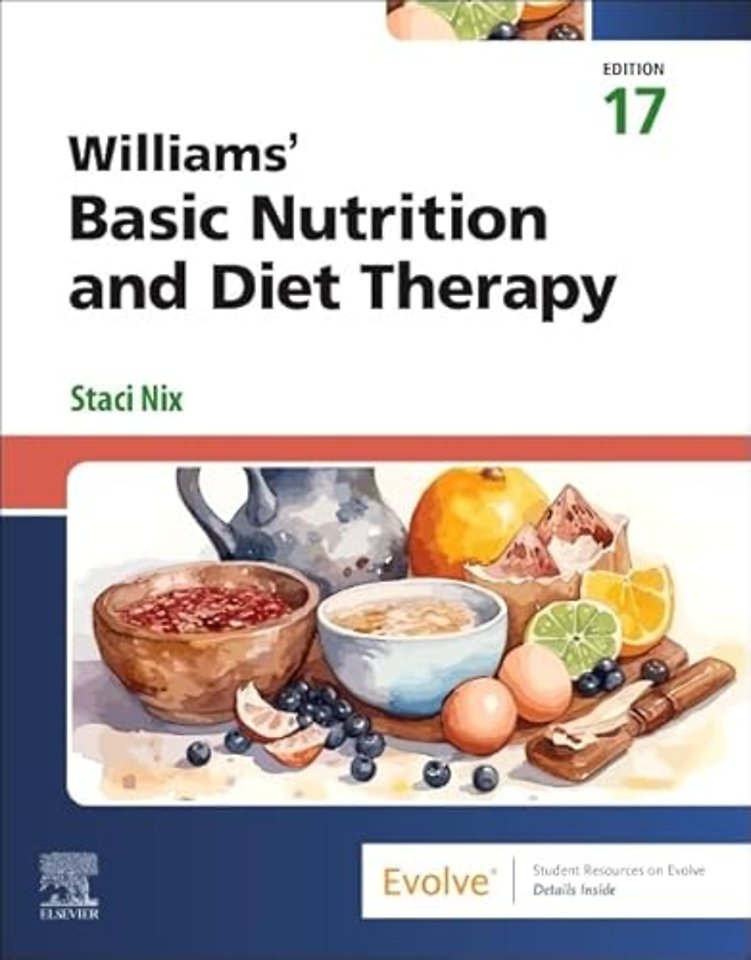
Williams' Basic Nutrition & Diet Therapy

Specificaties
Paperback, blz. | Engels
Elsevier Health Sciences | 2026
ISBN13: 9780443123641
Rubricering
Elsevier Health Sciences e druk, 2026 9780443123641
€ 114,74
Levertijd ongeveer 9 werkdagen
Gratis verzonden

Samenvatting

Stay up to date on the latest information in nutrition care with Williams' Basic Nutrition & Diet Therapy, 17th Edition. This leading text provides concise, need-to-know coverage of hot topics, emerging trends, and cutting-edge research to ensure you are equipped to make informed decisions on patient nutrition in the clinical space. A conversational writing style, vivid illustrations, and wide array of reader-friendly features connect the fundamental concepts of nutrition to the application of those concepts in clinical practice. The text is logically broken out into four parts: Part 1 introduces basic principles of nutrition science, including coverage of health promotion, vitamins, minerals, and other key foundational topics; Part 2 discusses human growth and development needs in different parts of the life cycle; Part 3 provides a strong focus on community nutrition, along with emphasis on weight management and physical fitness; Part 4 consists of a series of clinical nutrition chapters that reflect the latest medical nutrition therapy and approaches to patient education and care management.Clinical Judgment Case Studies with accompanying questions for analysis in the clinical care chapters focus attention on related patient care problemsCultural Considerations boxes discuss how a patient's culture can affect nutritional concepts in practiceClinical Applications and For Further Focus boxes highlight timely topics and analyze concepts and trends in depthBulleted chapter summaries review highlights from the chapter and help you see how the chapter contributes to the book's "big picture"Diet therapy guidelines include recommendations, restrictions, and sample diets for major clinical conditionsDrug-Nutrient Interactions boxes highlight important safety information and cover topics such as nutritional supplements for athletics, drugs interfering with vitamin absorption, and over-the-counter weight loss aidsKey terms and definitions clarify terminology and concepts critical to understanding and application of the materialUPDATED! Clinical guidelines align with the most recent recommendations, preparing you to implement best practicesUPDATED! Images and figures visually reinforce key conceptsUPDATED! Coverage of Healthy People 2030 and the 2023 DRI's for Energy bring you the latest objectives, formulas, and examplesUPDATED! Revised case studies and content reflect the diverse cultural backgrounds you may encounter in practice, encouraging culturally sensitive approaches to careEXPANDED! Discussions of key concepts backed by current longitudinal studies provide a stronger empirical foundation for decision-makingUPDATED! Statistics throughout the text reflect the most recently available data at the time of publication

Specificaties

ISBN13:9780443123641
Taal:Engels
Bindwijze:Paperback

Inhoudsopgave

PART 1 INTRODUCTION TO BASIC PRINCIPLES OF NUTRITION SCIENCE<br>1 Food Nutrition and Health <br>Health Promotion <br>Basic Definitions <br>Importance of a Balanced Diet <br>Functions of Nutrients <br>Energy Sources <br>Tissue Building <br>Regulation and Control <br>States of Nutrition <br>Optimal Nutrition <br>Malnutrition <br>Nutrient and Food Guides for Health <br>Nutrient Standards <br>Food Guides and Recommendations <br>Individual Needs <br><br>2 Carbohydrates <br>Nature of Carbohydrates <br>Dietary Importance <br>Structure and Classes of Carbohydrates <br>Functions of Carbohydrates <br>Energy Source <br>Metabolic Regulator <br>Food Sources of Carbohydrates <br>Starches <br>Sugars <br>Digestion of Carbohydrates <br>Mouth <br>Stomach <br>Small Intestine <br>Recommendations for Dietary Carbohydrates <br>Dietary Reference Intakes <br>Dietary Guidelines for Americans <br>MyPlate <br><br>3 Fats <br>Nature of Fats <br>Dietary Importance <br>Structure and Classes of Fats <br>Functions of Fat <br>Fat in Food <br>Fat in the Body <br>Food Sources of Fat <br>Fatty Acid Composition <br>Physical Characteristics of Food Fat <br>Food Label Information <br>Digestion of Fats <br>Mouth <br>Stomach <br>Small Intestine <br>Recommendations for Dietary Fat <br>Health Problems <br>Health Promotion <br>Dietary Reference Intakes <br>Dietary Guidelines for Americans <br>MyPlate <br><br>4 Proteins <br>Nature of Protein <br>Dietary Importance <br>Structure and Classes of Protein <br>Functions of Protein <br>Tissue Building <br>Additional Body Functions <br>Food Sources of Protein <br>Animal Protein <br>Plant Protein <br>Digestion of Protein <br>Mouth <br>Stomach <br>Small Intestine <br>Recommendations for Dietary Protein <br>Influential Factors of Protein Needs <br>Dietary Deficiency or Excess <br>Dietary Guides <br><br>5 Digestion Absorption and Metabolism <br>Digestion <br>Basic Principles <br>Mechanical and Chemical Digestion <br>Digestion in the Mouth and Esophagus <br>Digestion in the Stomach <br>Digestion in the Small Intestine <br>Absorption and Transport <br>Absorption in the Small Intestine <br>Absorption in the Large Intestine <br>Transport <br>Metabolism <br>Catabolism and Anabolism<br>Energy Density <br>Storing Extra Energy <br>Errors in Digestion and Metabolism <br>Inborn Errors of Metabolism <br>Intolerances and Allergies <br><br>6 Energy Balance <br>Human Energy System <br>Energy Needs <br>Measurement of Energy <br>Fuel for Energy <br>Energy Balance <br>Energy Intake <br>Energy Output <br>Recommendations for Dietary Energy Intake <br>Energy Needs Through the Life Cycle <br>Dietary Reference Intakes <br>Dietary Guidelines for Americans <br>MyPlate <br><br>7 Vitamins <br>The Nature of Vitamins <br>Definition <br>Functions of Vitamins <br>Vitamin Metabolism <br>Dietary Reference Intakes <br><br>SECTION 1 FAT-SOLUBLE VITAMINS <br>Vitamin A (Retinol) <br>Functions <br>Requirements <br>Deficiency <br>Toxicity <br>Food Sources and Stability <br>Vitamin D (Calciferol) <br>Functions <br>Requirements <br>Deficiency <br>Toxicity <br>Food Sources and Stability <br>Vitamin E (Tocopherol) <br>Functions <br>Requirements <br>Deficiency <br>Toxicity <br>Food Sources and Stability <br>Vitamin K (Phylloquinone) <br>Functions <br>Requirements <br>Deficiency <br>Toxicity <br>Food Sources and Stability <br><br>SECTION 2 WATER-SOLUBLE VITAMINS <br>Vitamin C (Ascorbic Acid) <br>Functions <br>Requirements <br>Deficiency <br>Toxicity <br>Food Sources and Stability <br>Vitamin B1 (Thiamin) <br>Functions <br>Requirements <br>Deficiency <br>Toxicity <br>Food Sources and Stability <br>Vitamin B2 (Riboflavin) <br>Functions <br>Requirements <br>Deficiency <br>Toxicity <br>Food Sources and Stability <br>Vitamin B3 (Niacin) <br>Functions <br>Requirements <br>Deficiency <br>Toxicity <br>Food Sources and Stability <br>Vitamin B6 (Pyridoxine) <br>Functions <br>Requirements <br>Deficiency <br>Toxicity <br>Food Sources and Stability <br>Vitamin B9 (Folate) <br>Functions <br>Requirements <br>Deficiency <br>Toxicity <br>Food Sources and Stability <br>Vitamin B12 (Cobalamin) <br>Functions <br>Requirements <br>Deficiency <br>Toxicity <br>Food Sources and Stability <br>Vitamin B5 (Pantothenic Acid) <br>Functions <br>Requirements <br>Deficiency <br>Toxicity <br>Food Sources and Stability <br>Vitamin B7 (Biotin) <br>Functions <br>Requirements <br>Deficiency <br>Toxicity <br>Food Sources and Stability <br>Choline <br>Functions <br>Requirements <br>Deficiency <br>Toxicity <br>Food Sources and Stability <br><br>SECTION 3 PLANT NUTRIENTS AND DIETARY SUPPLEMENTATION <br>Phytochemicals <br>Function<br>Recommended Intake <br>Food Sources <br>Nutrient Supplementation <br>Recommendations for Nutrient Supplementation <br>Supplementation Principles <br>Functional Foods <br><br>8 Minerals <br>Nature of Minerals in Human Nutrition <br>Definition <br>Functions of Minerals <br>Mineral Metabolism <br><br>SECTION 1 MAJOR MINERALS <br>Calcium <br>Functions <br>Requirements <br>Deficiency <br>Toxicity <br>Food Sources <br>Phosphorus <br>Functions <br>Requirements <br>Deficiency <br>Toxicity <br>Food Sources <br>Sodium <br>Functions <br>Requirements <br>Deficiency <br>Toxicity <br>Food Sources <br>Potassium <br>Functions <br>Requirements <br>Deficiency <br>Toxicity <br>Food Sources <br>Chloride <br>Functions <br>Requirements <br>Deficiency <br>Toxicity <br>Food Sources <br>Magnesium <br>Functions <br>Requirements <br>Deficiency <br>Toxicity <br>Food Sources <br>Sulfur <br>Functions <br>Requirements <br>Deficiency <br>Toxicity <br>Food Sources <br><br>SECTION 2 TRACE MINERALS <br>Iron <br>Functions <br>Requirements <br>Deficiency <br>Toxicity <br>Food Sources <br>Iodine <br>Functions <br>Requirements <br>Deficiency <br>Toxicity <br>Food Sources <br>Zinc <br>Functions <br>Requirements <br>Deficiency <br>Toxicity <br>Food Sources <br>Selenium <br>Functions <br>Requirements <br>Deficiency <br>Toxicity <br>Food Sources <br>Other Essential Trace Minerals <br>Fluoride <br>Copper <br>Manganese <br>Molybdenum <br>Chromium <br>Additional Trace Minerals <br><br>SECTION 3 MINERAL SUPPLEMENTATION <br>Life Cycle Needs <br>Pregnancy and Lactation <br>Adolescence <br>Adulthood <br>Clinical Needs <br><br>9 Water and Electrolyte Balance <br>Water The Fundamental Nutrient <br>Functions <br>Requirements <br>Dehydration <br>Water Intoxication <br>Water Balance <br>The Solvent <br>Solute Particles <br>Separating Membranes <br>Forces Moving Water and Solutes Across Membranes <br>Capillary Fluid Shift Mechanism <br>Organ System Circulation <br>Hormonal Controls <br>Acid-Base Balance <br>Acids and Bases <br>Buffer Systems <br>Alkalosis and Acidosis<br><br>PART 2 NUTRITION THROUGHOUT THE LIFE CYCLE<br>10 Nutrition During Pregnancy and Lactation <br>Nutritional Needs During Pregnancy <br>Energy Needs <br>Macronutrients <br>Key Micronutrients <br>Gestational Weight Gain <br>Meal Planning and Lifestyle Considerations <br>General Concerns <br>Common Gastrointestinal Discomforts <br>High-Risk Pregnancies <br>Pregnancy Complications <br>Lactation <br>Trends <br>The Baby-Friendly Hospital Initiative <br>Physiologic Process of Lactation <br>Nutrition and Lifestyle Needs <br>Long-Term Impacts of Feeding Methods <br>Additional Resources <br><br>11 Nutrition During Infancy Childhood and Adolescence <br>Growth and Development <br>Life Cycle Growth Pattern <br>Measuring Childhood Growth <br>Nutrition Requirements for Growth <br>Nutrition Requirements During Infancy <br>Infant Classifications <br>Considerations Regarding Feeding Premature Infants <br>What How and When to Feed the Mature Infant <br>Nutrition Requirements During Childhood <br>Toddlers (1 to 3 Years Old) <br>Preschool-Aged Children (3 to 5 Years Old) <br>School-Aged Children (5 to 12 Years Old) <br>Nutrition Problems During Childhood <br>Nutrition Requirements During Adolescence (12 to 18 Years Old) <br>Physical Growth <br>Eating Patterns <br>Disordered Eating <br><br>12 Nutrition for Adults The Early Middle and Later Years <br>Adulthood Growth and Development <br>Coming of Age in America <br>Shaping Influences on Adult Growth and Development <br>The Aging Process and Nutrition Needs <br>Physiologic Changes <br>Nutrition Requirements <br>Clinical Needs of the Older Adult <br>Health Promotion and Disease Prevention <br>Chronic Diseases of Aging <br>Community Resources <br>Government Programs for Older Americans <br>Professional Organizations and Resources <br>Alternative Living Arrangements <br>Congregate Care Arrangements <br>Continuing Care Retirement Communities <br>Assisted Living Facilities <br>Nursing Homes <br><br>PART 3 COMMUNITY NUTRITION AND HEALTH CARE<br>13 Community Food Supply and Health <br>Food Safety and Health Promotion <br>U S Food and Drug Administration <br>Food Labels <br>Food Technology <br>Agricultural Pesticides <br>Food Additives <br>Foodborne Illness <br>Prevalence <br>Food Safety <br>Food Contamination <br>Food Needs and Costs <br>Hunger and Malnutrition <br>Food Assistance Programs <br>Food Buying and Handling Practices <br><br>14 Weight Management <br>Body Weight Spectrum <br>Body Weight Versus Body Fat <br>Body Composition <br>Estimates of Ideal Weight Ranges <br>Obesity and Health <br>Causes of Obesity <br>Individual Differences and Intense Weight Reduction Practices <br>A Sound Weight Management Program <br>Essential Characteristics <br>Behavior Modification <br>Dietary Modification <br>Food Misinformation and Fads <br>Food Fads <br>What Is the Answer <br>Underweight <br>General Causes and Treatment <br>Disordered Eating <br><br>15 Nutrition and Physical Fitness <br>Physical Activity Recommendations and Benefits <br>Guidelines and Recommendations <br>Health Benefits <br>Types of Physical Activity <br>Meeting Personal Needs <br>Dietary Needs During Exercise <br>Muscle Action and Fuel <br>General Training Diet<br>Athletic Performance <br>Carbohydrate Loading <br>Pregame Meal <br>Nutrition During Exercise <br>Nutrition After Exercise Recovery <br>Hydration Before During and After Exercise <br>Ergogenic Aids and Misinformation <br><br>PART 4 CLINICAL NUTRITION<br>16 Nutrition Support <br>Nutrition Care Framework <br>Setting and Focus of Care <br>Health Care Team <br>Phases of the Care Process <br>Nutrition Assessment <br>Nutrition Diagnosis <br>Nutrition Intervention <br>Nutrition Monitoring and Evaluation <br>Diet-Drug Interactions <br>Drug-Food Interactions <br>Drug-Nutrient Interactions <br>Drug-Herb Interactions <br><br>17 Gastrointestinal and Accessory Organ Problems <br>Upper Gastrointestinal Tract <br>Mouth <br>Esophagus <br>Stomach and Duodenum Peptic Ulcer Disease <br>Lower Gastrointestinal Tract <br>Disorders of the Small Intestine <br>Disorders of the Large Intestine <br>Food Intolerances and Allergies <br>Food Intolerances <br>Food Allergies <br>Celiac Disease <br>Gastrointestinal Accessory Organs <br>Liver Disease <br>Gallbladder Disease <br>Pancreatitis <br><br>18 Coronary Heart Disease and Hypertension <br>Coronary Heart Disease <br>Atherosclerosis <br>Acute Cardiovascular Disease <br>Heart Failure <br>Hypertension <br>Incidence and Nature <br>High Blood Pressure Levels <br>Medical Nutrition Therapy for Hypertension <br>Additional Lifestyle Modifications <br>Education and Prevention <br>Nutrition Education <br>Principles of Education <br><br>19 Diabetes Mellitus <br>The Nature of Diabetes <br>Defining Factors <br>Classification of Diabetes Mellitus and Glucose Intolerance <br>Symptoms of Diabetes <br>The Metabolic Pattern of Diabetes <br>Energy Supply and Control of Blood Glucose <br>Abnormal Metabolism in Diabetes With Hyperglycemia <br>Long-Term Complications <br>General Management of Diabetes <br>Early Detection and Monitoring <br>Goals of Care <br>Medical Nutrition Therapy for Diabetes <br>Eating Patterns and Nutrients <br>Coordinating Nutrient Intake With Medications and Physical Activity <br><br>20 Kidney Disease <br>Structure and Function of the Kidney <br>Structure <br>Function <br>Disease Processes and Dietary Considerations <br>General Causes of Kidney Disease <br>Medical Nutrition Therapy in Kidney Disease <br>Nephron Diseases <br>Acute Glomerulonephritis or Nephritic Syndrome <br>Nephrotic Syndrome <br>Kidney Failure <br>Acute Kidney Injury <br>Chronic Kidney Disease <br>End-Stage Renal Disease <br>Kidney Stone Disease <br>Disease Process <br>Medical Nutrition Therapy for Nephrolithiasis <br><br>21 Surgery and Nutrition Support <br>Nutrition Needs of General Surgery Patients <br>Preoperative Nutrition Care Nutrient Reserves <br>Postoperative Nutrition Care Nutrient Needs for Healing <br>General Dietary Management <br>Initial Intravenous Fluid and Electrolytes <br>Methods of Nutrition Support <br>Special Nutrition Needs After Gastrointestinal Surgery <br>Mouth Throat and Neck Surgery <br>Gastric Surgery <br>Bariatric Surgery <br>Gallbladder Surgery <br>Intestinal Surgery <br>Rectal Surgery<br>Special Nutrition Needs for Patients With Burns <br>Type and Extent of Burns <br>Postburn Metabolic Phases <br>Medical Nutrition Therapy for Patients With Major Burns <br><br>22 Nutrition Support in Cancer and HIV<br>SECTION 1 CANCER <br>Cancer Progression <br>Cancer Cell Development <br>The Body&rsquo;s Defense System <br>Nutrition Complications of Cancer Treatment <br>Surgery <br>Radiation <br>Chemotherapy <br>Drug-Nutrient Interactions <br>Medical Nutrition Therapy in the Patient With Cancer <br>Nutrition-Related Complications of Cancer <br>Nutrition Care Plan <br>Cancer Prevention <br>Guidelines for Cancer Prevention <br>Diets and Supplements <br><br>SECTION 2 HUMAN IMMUNODEFICIENCY VIRUS <br>Progression of Human Immunodeficiency Virus <br>Evolution of Human Immunodeficiency Virus <br>Host-Dependent Replication <br>Transmission and Stages of Disease Progression <br>Medical Management of Patients With Human Immunodeficiency Virus <br>Initial Evaluation and Goals <br>Drug Therapy <br>Vaccine Development <br>Medical Nutrition Therapy in the Patient With Human Immunodeficiency Virus <br>Nutrition-Related Complications of Human Immunodeficiency Virus <br>Nutrition Care Plan <br>Nutrition Counseling Education and Supportive Care <br><br>References <br>Further Reading and Resources <br>Glossary <br>Appendix A Answers to Chapter Review Questions <br>Appendix B Dietary Reference Intakes <br>Appendix C Average Sodium and Potassium Content of Foods 100 g Edible Portion
€ 114,74
Levertijd ongeveer 9 werkdagen
Gratis verzonden

Rubrieken

    Personen

      Trefwoorden

        Williams' Basic Nutrition & Diet Therapy