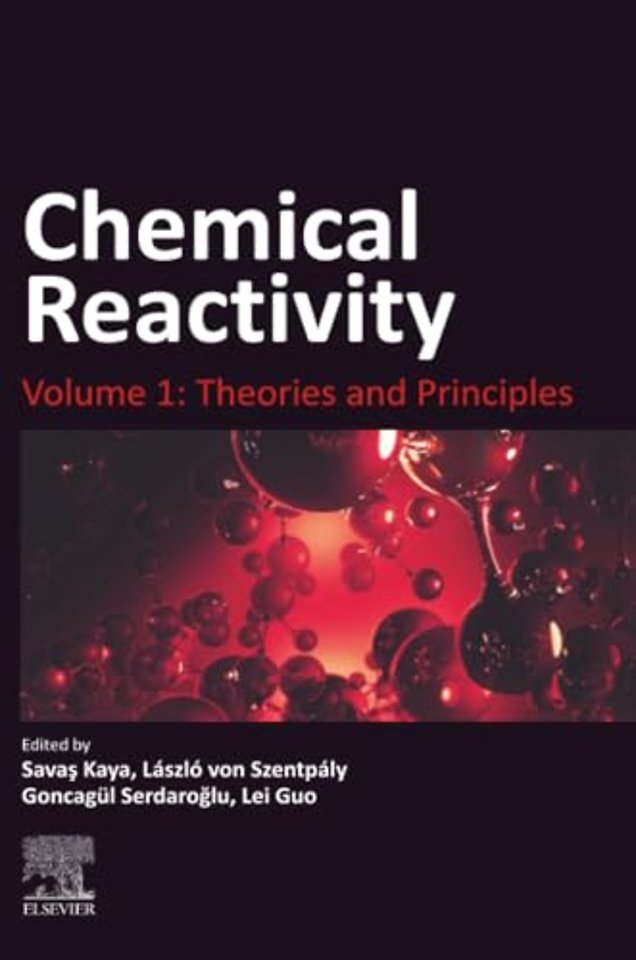
, , , e.a.

Chemical Reactivity

Volume 1: Theories and Principles

Specificaties
Paperback, blz. | Engels
Elsevier Science | 2023
ISBN13: 9780323902571
Rubricering
Elsevier Science e druk, 2023 9780323902571
€ 211,00
Levertijd ongeveer 9 werkdagen
Gratis verzonden

Samenvatting

The growth of technology for chemical assessment has led to great developments in the investigation of chemical reactivity in recent years, but key information is often dispersed across many different research fields. Combining both original principles and the cutting-edge theories used in chemical reactivity analysis, Chemical Reactivity, Volume 1 present the latest developments in theoretical chemistry and its application for the assessment of chemical processes.

Beginning with an exploration of different theories and principles relating to electronic structure and reactivity of confined electronic systems, the book goes on to highlight key information on such topics as Dyson orbitals, target-ion overlaps, reaction fragility, magnetizability principles and the Fuki function. Density Functional Theory is discussed in relation to numerous different principles and approaches, with further information on constrained methods and diabatic models, bonding evolution theory, orbital-based population analysis models and charge transfer models, and Quantum chemistry and QTAIM.

Consolidating the knowledge of a global team of experts in the field, Chemical Reactivity, Volume 1: Theories and Principles is a useful resource for both students and researchers interested in gaining greater understanding of the principles and theories underpinning chemical reactivity analysis.

Specificaties

ISBN13:9780323902571
Taal:Engels
Bindwijze:Paperback

Inhoudsopgave

<p>1. The importance of correlation in the molecular orbital picture</p> <p>2. Dyson orbitals and chemical bonding</p> <p>3. Coupled-cluster theory and chemical reactivity</p> <p>4. New developments in the Interacting Quantum Atoms (IQA) approach</p> <p>5. Conceptual Ruedenberg theory of chemical bonds: the necessary step beyond conceptual DFT</p> <p>6. Electron-density-based analysis and electron density functional theory (DFT) methods</p> <p>7. Information-theoretic concepts in theory of electronic structure and chemical reactivity</p> <p>8. Excited-state density functional theory</p> <p>9. Reaction fragility method: monitoring evolution of atoms and bonds on a reaction path</p> <p>10. Looking behind the scenes of Grubbs catalysis with the Unified Reaction Valley Approach</p> <p>11. The diabatic model of intermediate stabilization for reaction mechanism analysis: a link to valence bond and Marcus theories</p> <p>12. Main concepts and applications of DFTB approach</p> <p>13. Chemical reactivity insights from the use of constrained methods</p> <p>14. On the analysis of the Fukui function</p> <p>15. Analytic calculation of Fukui functions and related reactivity descriptors</p> <p>16. New insights from a bonding evolution theory based on the topological analysis of the electron localization function</p> <p>17. Experimental quantum chemistry and chemical reactivity</p> <p>18. Quantum similarity description of a unique classical and quantum QSPR algorithm in molecular spaces: the connection with Boolean hypercubes, algorithmic intelligence, and Gödel’s incompleteness theorems</p>
€ 211,00
Levertijd ongeveer 9 werkdagen
Gratis verzonden

Rubrieken

    Personen

      Trefwoorden

        Chemical Reactivity