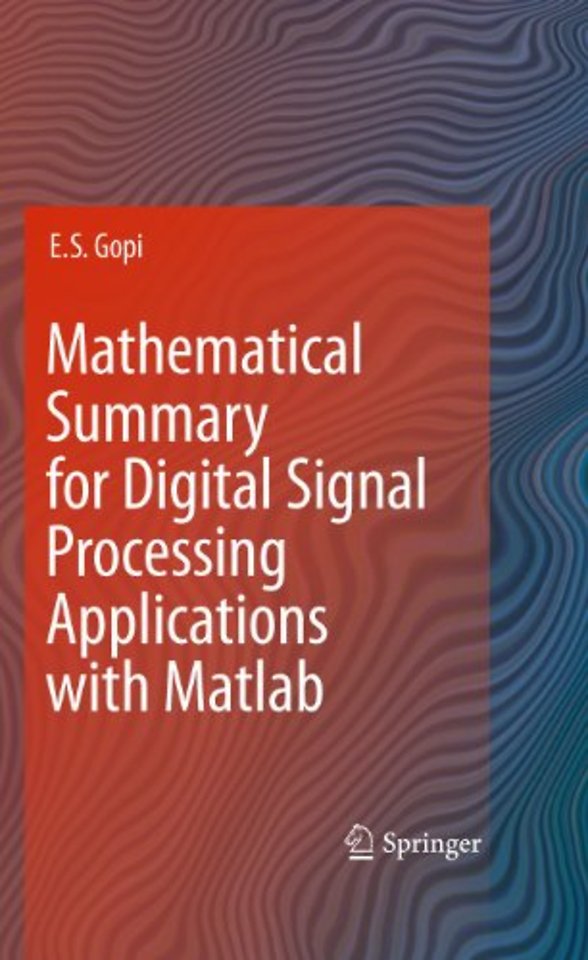
E. S. Gopi
Springer Netherlands
e druk, 2014
9789400790858
Mathematical Summary for Digital Signal Processing Applications with Matlab
Specificaties
Paperback, blz.
|
Engels
Springer Netherlands |
2014
ISBN13: 9789400790858
Rubricering
Levertijd ongeveer 9 werkdagen
Gratis verzonden
Samenvatting
Mathematical summary for Digital Signal Processing Applications with Matlab consists of Mathematics which is not usually dealt in the DSP core subject, but used in DSP applications. Matlab programs with illustrations are given for the selective topics such as generation of Multivariate Gaussian distributed sample outcomes, Bacterial foraging algorithm, Newton’s iteration, Steepest descent algorithm, etc. are given exclusively in the separate chapter. Also Mathematical summary for Digital Signal Processing Applications with Matlab is written in such a way that it is suitable for Non-Mathematical readers and is very much suitable for the beginners who are doing research in Digital Signal Processing.
Specificaties
ISBN13:9789400790858
Taal:Engels
Bindwijze:paperback
Uitgever:Springer Netherlands
Inhoudsopgave
1. Matrices. 1-1 Properties of vectors. 1-2 Properties of Matrices. 1-3 LDU Decomposition of the arbitrary matrix. 1-4 PLDU Decomposition of the arbitrary matrix. 1-5 Vector space and its properties. 1-6 Linear independence, Span, Basis and the Dimension of the Vector Space. 1-7 Four Fundamental Vector spaces of the Matrix. 1-8 Basis of the Four Fundamental Vector spaces of the Matrix. 1-9 Observations on the Results of the Example 1-12. 1-10 Vector Representation with different basis. 3-11 Linear transformation of the vector. 1-12 Transformation matrix with different basis (Similar Matrices). 3-13 Orthogonality. 1-14 System of Linear Equation. 1-15 Solutions for the system of Linear Equation [A] x = b. 1-16 Gram-Schmidt Orthogonalization procedure for obtaining orthonormal basis. 1-17 QR Factorization. 1-18 Eigen values and the Eigen Vectors. 1-19 Geometric Multiplicity (vs) Algebraic Multiplicity. 1-20 Diagonalization of the matrix. 1-21 Schur’s Lemma. 1-22 Hermitian Matrices. 1-23 Unitary Matrices. 3-24 Normal Matrices. 1-25 Applications of Diagonalization of the non-deficient matrix. 1-26 Singular Value Decomposition(SVD). 1-27 Applications of Singular Value Decomposition.
2. Probability. 2-1 Introduction. 2-2 Axioms of Probability. 2-3 Class of Events or Field(F). 2-4 Probability Space (S,F,P). 2-5 Probability measure. 2-6 Conditional Probability. 2-7 Total Probability Theorem. 2-8 Bayes Theorem. 2-9 Independence. 2-10 Multiple Experiments. 2-11 Random Variable. 2-12 Cumulative Distribution Function(cdf) of the random variable ‘x’. 2-13 Continuous Random variable. 2-14 Discrete Random variable. 2-15 Probability mass function. 2-16 Probability density function. 2-17 Two Random variables. 2-18 Conditional distributions and densities. 2-19 Independent Random variables. 2-20 Some Important results on conditional density function. 2-21 Transformation of the Random variables of the type Y=g(X). 2-22Transformation of the Random variables of the type Y1=g1(X1,X2), Y2=g2(X1,X2). 2-23 Expectations. 2-24 Indicator. 2-25 Moment Generating function. 2-26 Characteristic function. 2-27 Multiple Random Variable (Random Vectors). 2-28 Gaussian random vector with mean vector µx and covariance matrix Cx. 2-29 Complex Random variables. 2-30 Sequence of the Number and its convergence. 2-31 Sequence of the functions and its convergence. 2-32 Sequence of the Random variable. 2-33 Example for the sequence of random variable. 2-34 Central Limit Theorem.
3. Random Process. 3-1 Introduction. 3-2 Random variable Xt1. 3-3 Strictly stationary Random Process with order 1. 3-4 Strictly stationary Random Process with order 2. 3-5 Wide Sense stationary Random Process. 3-6 Complex Random Process. 3-7 Properties of Real and Complex Random Process. 3-8 Jointly Strictly Stationary of two Random Process. 3-9 Jointly Wide Sense Stationary of two Random Process. 3-10 Correlation matrix of the random column vector [Xt Xs] for the specific ‘t’ and ‘s’. 3-11 Ergodic process. 3-12 Independent Random process. 3-13 Uncorrelated Random process. 3-14 Random process as the input and output of the system. 3-15 Power Spectral density. 3-16 White Random process. 3-17 Gaussian Random process. 3-18 Cyclo stationary Random process. 3-19 Wide sense Cyclo stationary Random Process. 3-20 Sampling and Reconstruction of the Random Process. 3-21 Band Pass Random Process. 3-22 Random Process as the input to the Hilbert transformation as the system. 3-23 Two jointly W.S.S Low pass Random process obtained using W.S.S. Band pass Random process and its Hilbert transformation.
4. Linear Algebra. 4-1 Vector space. 4-2 Linear Transformation. 4-3 Direct Sum. 4-4 Transformation Matrix. 4-5 Similar Matrix. 4-6 Structure Theorem. 4-7 Properties of Eigen Space. 4-8 Properties of Generalized Eigen space. 4-9
2. Probability. 2-1 Introduction. 2-2 Axioms of Probability. 2-3 Class of Events or Field(F). 2-4 Probability Space (S,F,P). 2-5 Probability measure. 2-6 Conditional Probability. 2-7 Total Probability Theorem. 2-8 Bayes Theorem. 2-9 Independence. 2-10 Multiple Experiments. 2-11 Random Variable. 2-12 Cumulative Distribution Function(cdf) of the random variable ‘x’. 2-13 Continuous Random variable. 2-14 Discrete Random variable. 2-15 Probability mass function. 2-16 Probability density function. 2-17 Two Random variables. 2-18 Conditional distributions and densities. 2-19 Independent Random variables. 2-20 Some Important results on conditional density function. 2-21 Transformation of the Random variables of the type Y=g(X). 2-22Transformation of the Random variables of the type Y1=g1(X1,X2), Y2=g2(X1,X2). 2-23 Expectations. 2-24 Indicator. 2-25 Moment Generating function. 2-26 Characteristic function. 2-27 Multiple Random Variable (Random Vectors). 2-28 Gaussian random vector with mean vector µx and covariance matrix Cx. 2-29 Complex Random variables. 2-30 Sequence of the Number and its convergence. 2-31 Sequence of the functions and its convergence. 2-32 Sequence of the Random variable. 2-33 Example for the sequence of random variable. 2-34 Central Limit Theorem.
3. Random Process. 3-1 Introduction. 3-2 Random variable Xt1. 3-3 Strictly stationary Random Process with order 1. 3-4 Strictly stationary Random Process with order 2. 3-5 Wide Sense stationary Random Process. 3-6 Complex Random Process. 3-7 Properties of Real and Complex Random Process. 3-8 Jointly Strictly Stationary of two Random Process. 3-9 Jointly Wide Sense Stationary of two Random Process. 3-10 Correlation matrix of the random column vector [Xt Xs] for the specific ‘t’ and ‘s’. 3-11 Ergodic process. 3-12 Independent Random process. 3-13 Uncorrelated Random process. 3-14 Random process as the input and output of the system. 3-15 Power Spectral density. 3-16 White Random process. 3-17 Gaussian Random process. 3-18 Cyclo stationary Random process. 3-19 Wide sense Cyclo stationary Random Process. 3-20 Sampling and Reconstruction of the Random Process. 3-21 Band Pass Random Process. 3-22 Random Process as the input to the Hilbert transformation as the system. 3-23 Two jointly W.S.S Low pass Random process obtained using W.S.S. Band pass Random process and its Hilbert transformation.
4. Linear Algebra. 4-1 Vector space. 4-2 Linear Transformation. 4-3 Direct Sum. 4-4 Transformation Matrix. 4-5 Similar Matrix. 4-6 Structure Theorem. 4-7 Properties of Eigen Space. 4-8 Properties of Generalized Eigen space. 4-9