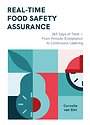
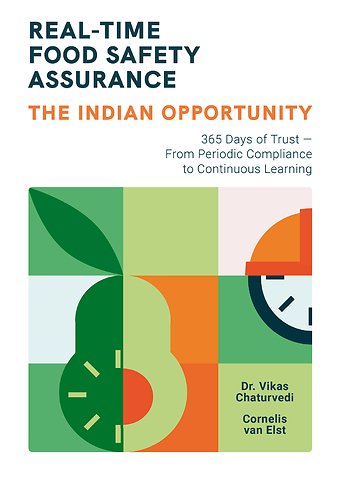
Real-Time Food Safety Assurance - the Indian opportunity
365 Days of Trust — From Periodic Compliance to Continuous Learning
Samenvatting
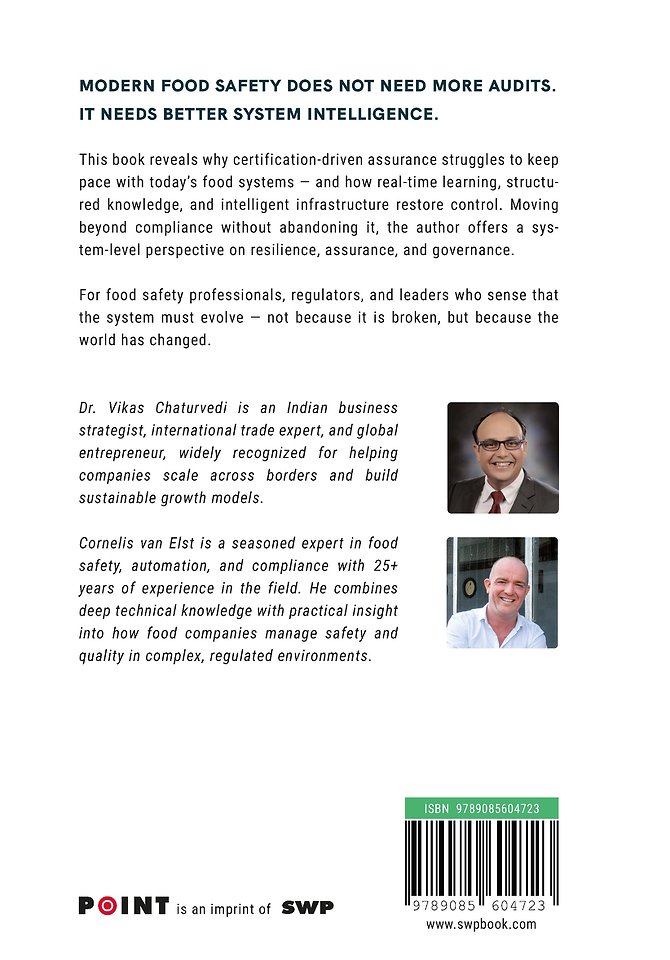
MODERN FOOD SAFETY DOES NOT NEED MORE AUDITS.
IT NEEDS BETTER SYSTEM INTELLIGENCE.
This book reveals why certification-driven assurance struggles to keep
pace with today’s food systems — and how real-time learning, structured
knowledge, and intelligent infrastructure restore control. Moving
beyond compliance without abandoning it, the author offers a system-
level perspective on resilience, assurance, and governance.
For food safety professionals, regulators, and leaders who sense that
the system must evolve — not because it is broken, but because the
world has changed.
Dr. Vikas Chaturvedi is an Indian business
strategist, international trade expert, and global
entrepreneur, widely recognized for helping
companies scale across borders and build
sustainable growth models.
Cornelis van Elst is a seasoned expert in food
safety, automation, and compliance with 25+
years of experience in the field. He combines
deep technical knowledge with practical insight
into how food companies manage safety and
quality in complex, regulated environments.
Specificaties
Inhoudsopgave
About the Author — Ir. Cornelis van Elst 11
About the Co-Author — Dr. Vikas Chaturvedi 13
Executive Summary 15
Who This Book Is For 19
Overview of the Book 21
Part I How CertIfICatIon BeCame tHe CeIlIng
1. Chasing the Highest Certificate Keeps Companies in Phase 1 29
2. Certification Keeps Companies Stuck in Phase 1 (Because the System Does) 33
3. The Big TIC Phase-1 Trap 37
4. Why Passing Audits Does Not Mean an Organization Is in Control 40
5. Phase 1 Is Necessary — Remaining There Is the Risk 43
Part II food Safety aS a learnIng SyStem
6. Food Safety as a Knowledge-Intensive Function 49
7. Food Safety as a Learning Organization 52
8. Managing the Five Food Safety Knowledge Domains 55
9. Why Knowledge — Not Documentation — Determines Maturity 58
10. From Individual Expertise to Organizational Intelligence 60
11. The Question Every Leadership Team Should Ask 62
Part III Beyond PdCa: SenSe & reSPond
12. PDCA Was Designed for a Slower World 67
13. From PDCA to Sense & Respond 70
14. Why PDCA Costs Become Distorted in the Big TIC Model 73
15. Real-Time Assurance Restores Balance 76
Part IV tHe CollaPSe of dePendenCy modelS
16. Why the Traditional Consultant Model in Food Safety Is Breaking Down 81 17. Stop Paying €1,300 a Day for Dependency 84
18. Good Auditors in a System That Constrains Learning 87
19. The New Audit Reality That Remains Largely Unspoken 90
20. Real-Time Assurance Is Not Anti-Audit 93
Part V InfraStruCture, SoVereIgnty, and g2B modelS
21. From Paper Compliance to Live Assurance 99
22. Real-Time Food Safety Assurance Is No Longer a Vision 103
23. Who Owns the Knowledge Domains Owns the Infrastructure 106
24. Sovereign Real-Time Food Safety Is Ready for G2B Programs 109
25. From €60k to €4k — Why G2B Changes Everything 112
26. Why Emerging Economies Should Skip the Audit Era 115
Part VI aI and SyStem IntellIgenCe
27. AI Will Not Fix Food Safety Without a Knowledge Backbone 121
28. How AI Supervision Becomes Possible 124
Part VII Power, eConomICS, and tHe way forward
29. Why Private Equity Is Attracted to Phase-1 Models 129
30. Why Food Safety Needs Infrastructure — Not Roll-Ups 132
31. We Do Not Need More Certificates — We Need System Intelligence 135
Part VIII – IndIa Beyond SuPPly: rePoSItIonIng IndIa In euroPe’S food eConomy 32. India in a Recalibrating Global Food System 141
33. Decoding the Export Dissonance 143
34. The Three Structural Shifts 145
35. MSMEs: Built Small, Competing Global 147
Closing Note — An Epilogue 149
Appendix 1 151
Appendix 2 155
Appendix 3 157
Appendix 4 162
Appendix 5 170
Appendix 6 174
Appendix 7 178
Appendix 8 182
Vaak samen gekocht


Anderen die dit kochten, kochten ook
-
 Sebastiaan van de Water€ 13,75
 -
Rob Baan€ 29,95
-
Ir. Cornelis van Elst€ 34,50