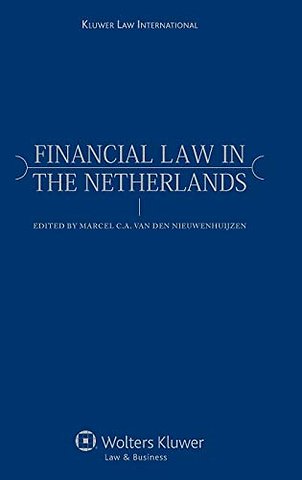
Financial law in the Netherlands
Samenvatting
The Netherlands is one of a handful of countries in which bank enterprise and
national financial law give rise to a large number of international financial
transactions. It is important then for practitioners in other countries to
gain more than a notional understanding of the specific features of Dutch
financial law, as well as a clear working knowledge of how Dutch financial law
interacts with supranational regulatory and policy regimes affecting financial
transactions.
Toward this end, this very useful book provides a practical but nevertheless
thorough survey of Dutch financial law, with lucid explanations of such topics
as the following:
• specific rules applicable to investment institutions;
• specific rules applicable to debt instruments;
• offering securities in both primary and secondary markets;
• set-off and calculation of obligations of market participants (netting);
• structures for custody and book-entry transfer of securities;
• obtaining and terminating listings;
• mandatory bids, competing bids, friendly and unfriendly bids under public
offering regulations;
• alternative investment funds and fund governance;
• meaning, jargon and function of derivatives, forwards, futures, options,
swaps, etc.;
• securities repurchase and lending transactions;
• covered bond regulations;
• caretaking duties in private and public law;
• structure of legal proceedings of a prospectus liability claim;
• unfair commercial practices rules;
• case law in insider trading and market manipulation; and
• securities litigation in Dutch private, criminal, and administrative law.
Written in clear, easy-to-follow English, this book makes Dutch financial law
accessible to lawyers, business persons, and others whose work entails
financial transactions in the Netherlands. It also serves as an admirable text
for students and academics in the field of financial law.
Specificaties
Anderen die dit boek kochten, kochten ook
-
 B.J. Huiskes€ 89,00
 -
M.K. Shahid€ 42,95
-
Alex Meijer€ 29,50
-
R.C. Stam€ 52,00
-
Drs.W.F.A. Eiselin€ 120,75
-
K. Lindenberg€ 62,50