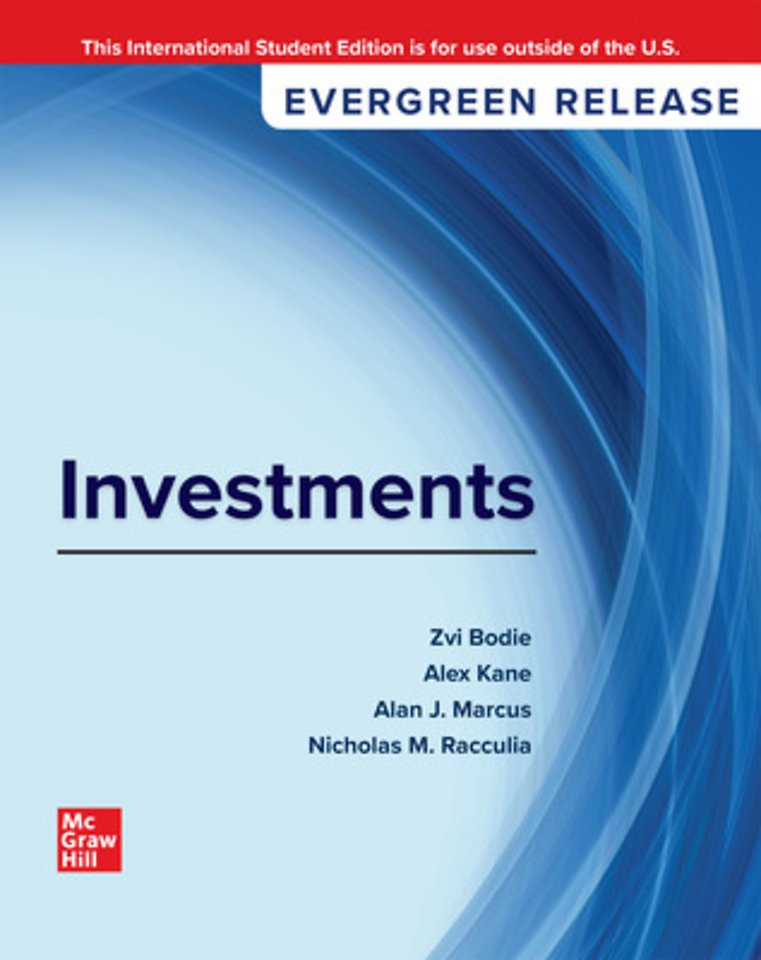
Zvi Bodie
McGraw-Hill Education
14e druk, 2026
9781265967031
Investments: 2026 Release ISE
Specificaties
Paperback, blz.
|
Engels
McGraw-Hill Education |
14e druk, 2026
ISBN13: 9781265967031
Rubricering
Levertijd ongeveer 8 werkdagen
Gratis verzonden
Samenvatting
Investments serves as a graduate (MBA) text designed primarily for investment analysis courses. It presents material through a framework rooted in fundamental principles, addressing key issues relevant to investors. Aligning with the CFA Institute, the authors ensure the text complements the CFA curriculum. The central theme is the near-efficiency of security markets, emphasizing that most securities are priced correctly based on their risk and return, while highlighting that competitive markets do not provide 'free lunches' to participants. A second theme explores the risk-return trade-off, while also emphasizing asset allocation and providing an in-depth look at futures, options, and derivatives.
Specificaties
ISBN13:9781265967031
Taal:Engels
Bindwijze:paperback
Uitgever:McGraw-Hill Education
Druk:14
Verschijningsdatum:13-2-2026
Hoofdrubriek:Financieel management
Inhoudsopgave
Part I: Introduction
1. The Investment Environment
2. Asset Classes and Financial Instruments
3. How Securities Are Traded
4. Mutual Funds and Other Investment Companies
Part II: Portfolio Theory and Practice
5. Risk, Return, and the Historical Record
6. Capital Allocation to Risky Assets
7. Efficient Diversification
8. Index Models
Part III: Equilibrium in Capital Markets
9. The Capital Asset Pricing Model
10. Arbitrage Pricing Theory and Multifactor Models of Risk and Return
11. The Efficient Market Hypothesis
12. Behavioral Finance and Technical Analysis
13. Empirical Evidence on Security Returns
Part IV: Fixed-Income Securities
14. Bond Prices and Yields
15. The Term Structure of Interest Rates
16. Managing Bond Portfolios
Part V: Security Analysis
17. Macroeconomic and Industry Analysis
18. Equity Valuation Models
19. Financial Statement Analysis
Part VI: Options, Futures, and Other Derivatives
20. Options Markets: Introduction
21. Option Valuation
22. Futures Markets
23. Futures, Swaps, and Risk Management
Part VII: Applied Portfolio Management
24. Portfolio Performance Evaluation
25. International Diversification
26. Alternative Assets
27. The Theory of Active Portfolio Management
28. Investment Policy and the Framework of the CFA Institute
References to CFA Problems
1. The Investment Environment
2. Asset Classes and Financial Instruments
3. How Securities Are Traded
4. Mutual Funds and Other Investment Companies
Part II: Portfolio Theory and Practice
5. Risk, Return, and the Historical Record
6. Capital Allocation to Risky Assets
7. Efficient Diversification
8. Index Models
Part III: Equilibrium in Capital Markets
9. The Capital Asset Pricing Model
10. Arbitrage Pricing Theory and Multifactor Models of Risk and Return
11. The Efficient Market Hypothesis
12. Behavioral Finance and Technical Analysis
13. Empirical Evidence on Security Returns
Part IV: Fixed-Income Securities
14. Bond Prices and Yields
15. The Term Structure of Interest Rates
16. Managing Bond Portfolios
Part V: Security Analysis
17. Macroeconomic and Industry Analysis
18. Equity Valuation Models
19. Financial Statement Analysis
Part VI: Options, Futures, and Other Derivatives
20. Options Markets: Introduction
21. Option Valuation
22. Futures Markets
23. Futures, Swaps, and Risk Management
Part VII: Applied Portfolio Management
24. Portfolio Performance Evaluation
25. International Diversification
26. Alternative Assets
27. The Theory of Active Portfolio Management
28. Investment Policy and the Framework of the CFA Institute
References to CFA Problems
Anderen die dit boek kochten, kochten ook
-
 Zvi Bodie€ 94,38
 -
IFRS€ 220,11
-
Aad van der Zalm€ 20,00
-
Gijs Hiltermann€ 20,00
-
Gijs Hiltermann€ 20,00
-
Wim Broerse€ 77,95