R. B. Lehoucq,
R.b. Lehoucq,
D. C. Sorensen,
D.c. Sorenson,
C. Yang
e.a.
Society for Industrial and Applied Mathematics
e druk, 1987
9780898714074
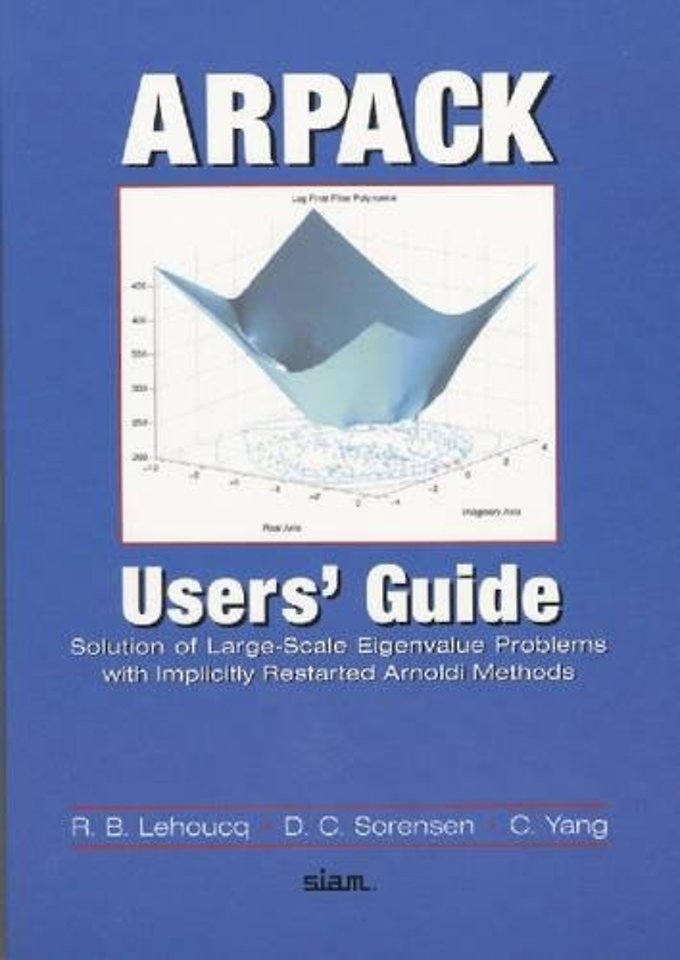
ARPACK Users' Guide
Solution of Large-Scale Eigenvalue Problems with Implicitly Restarted Arnoldi Methods
Specificaties
Paperback, 158 blz.
|
Engels
Society for Industrial and Applied Mathematics |
1987
ISBN13: 9780898714074
Rubricering
Onderdeel van serie
Software, Environmen
Levertijd ongeveer 9 werkdagen
Gratis verzonden
Samenvatting
This book is a guide to understanding and using the software package ARPACK to solve large algebraic eigenvalue problems. The software described is based on the implicitly restarted Arnoldi method, which has been heralded as one of the three most important advances in large scale eigenanalysis in the past ten years. The book explains the acquisition, installation, capabilities, and detailed use of the software for computing a desired subset of the eigenvalues and eigenvectors of large (sparse) standard or generalized eigenproblems. It also discusses the underlying theory and algorithmic background at a level that is accessible to the general practitioner.
Specificaties
ISBN13:9780898714074
Taal:Engels
Bindwijze:Paperback
Aantal pagina's:158
Uitgever:Society for Industrial and Applied Mathematics
Serie:Software, Environmen
Inhoudsopgave
List of figures; List of tables; Preface; 1. Introduction to ARPACK. Important features; Getting started; Reverse communication interface; Availability; Installation; Documentation; Dependence on LAPACK and BLAS; Expected performance; P_ARPACK; Contributed additions; Trouble shooting and problems; 2. Getting started with ARPACK. Directory structure and contents; Getting started; An example for a symmetric Eigenvalue problem; 3. General use of ARPACK. Naming conventions, Precisions, and types; Shift and invert spectral transformation mode; Reverse communication structure for shift-Invert; Using the computational modes; Computational modes for real symmetric problems; Postprocessing for Eigenvectors using dseupd; Computational modes for real nonsymmetric problems; Postprocessing for Eigenvectors Using dneupd; Computational modes for complex problems; Postprocessing for Eigenvectors Using zneupd; 4. The implicitly restarted Arnoldi method: structure of the Eigenvalue problem; Krylov subspaces and projection methods; The Arnoldi factorization; Restarting the Arnoldi method; The generalized Eigenvalue problem; Stopping Criterion; 5. Computational routines. ARPACK subroutines; LAPACK routines used by ARPACK; BLAS routines used by ARPACK; Appendix A. Templates and driver routines; Symmetric drivers; Real Nonsymmetric drivers; Complex drivers; Band drivers; The singular value decomposition; Appendix B. Tracking the progress of ARPACK. Obtaining trace output; Check-pointing ARPACK; Appendix C. The XYaupd ARPACK Routines. DSAUPD; DNAUPD; ZNAUPD; Bibliography; Index.